
Loading Shopping Cart Items...
Catalog
Instructor led
Added:08/19/2020 12:21 PM
September 22, 2020 | 1:00 - 2:00 PM Eastern Time
CME Information: 1.0 credit
Speaker(s): Amer Johri, MD, FASE & Henrik Sillesen, MD, DMSc
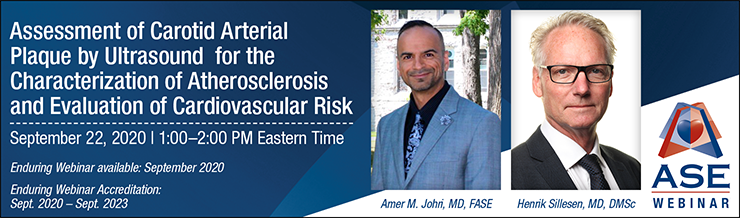
Join Amer Johri, MD , FASE and Henrik Sillesen, MD, DMSc in discussing the advantages and disadvantages of two-dimensional (2D) and three-dimensional (3D) ultrasound methods for carotid arterial plaque quantification are reviewed. Advanced and emerging methods of carotid arterial plaque activity and composition analysis by ultrasound are considered. Recommendations for the standardization of focused 2D and 3D carotid arterial plaque ultrasound image acquisition and measurement for the purpose of cardiovascular disease stratification are formulated.
CME Information: 1.0 credit
Speaker(s): Amer Johri, MD, FASE & Henrik Sillesen, MD, DMSc
Join Amer Johri, MD , FASE and Henrik Sillesen, MD, DMSc in discussing the advantages and disadvantages of two-dimensional (2D) and three-dimensional (3D) ultrasound methods for carotid arterial plaque quantification are reviewed. Advanced and emerging methods of carotid arterial plaque activity and composition analysis by ultrasound are considered. Recommendations for the standardization of focused 2D and 3D carotid arterial plaque ultrasound image acquisition and measurement for the purpose of cardiovascular disease stratification are formulated.
Credits awarded per Session. See individual Sessions for further details.
Credits awarded
Type
Name
Sub type
Value
Certificate awarded
About this item
September 22, 2020 | 1:00 - 2:00 PM Eastern Time
CME Information: 1.0 credit
Speaker(s): Amer Johri, MD, FASE & Henrik Sillesen, MD, DMSc
Join Amer Johri, MD , FASE and Henrik Sillesen, MD, DMSc in discussing the advantages and disadvantages of two-dimensional (2D) and three-dimensional (3D) ultrasound methods for carotid arterial plaque quantification are reviewed. Advanced and emerging methods of carotid arterial plaque activity and composition analysis by ultrasound are considered. Recommendations for the standardization of focused 2D and 3D carotid arterial plaque ultrasound image acquisition and measurement for the purpose of cardiovascular disease stratification are formulated.
Course/Activity Information
Target Audience: Cardiac sonographers, cardiologists, residents, clinicians, and other medical professionals.
Learning Objectives:
- Understand the standard method for carotid arterial plaque quantification recommended by the ASE using 2- or 3- dimensionally derived plaque height.
- Become familiar with other methods of arterial plaque measurement such as plaque score, plaque area, and plaque volume, including their advantages and disadvantages
- Understand the clinical context within which carotid arterial plaque quantification enhances cardiovascular risk stratification
- Become familiar with emerging techniques for carotid arterial plaque composition assessment and its role in detecting the vulnerable patient.
Ratings and reviews
Type:
Name:
Sub type:
Value: